Cart 0


How Long Does PPC Take?
So, how long does PPC take? PPC advertising can start generating traffic and clicks within
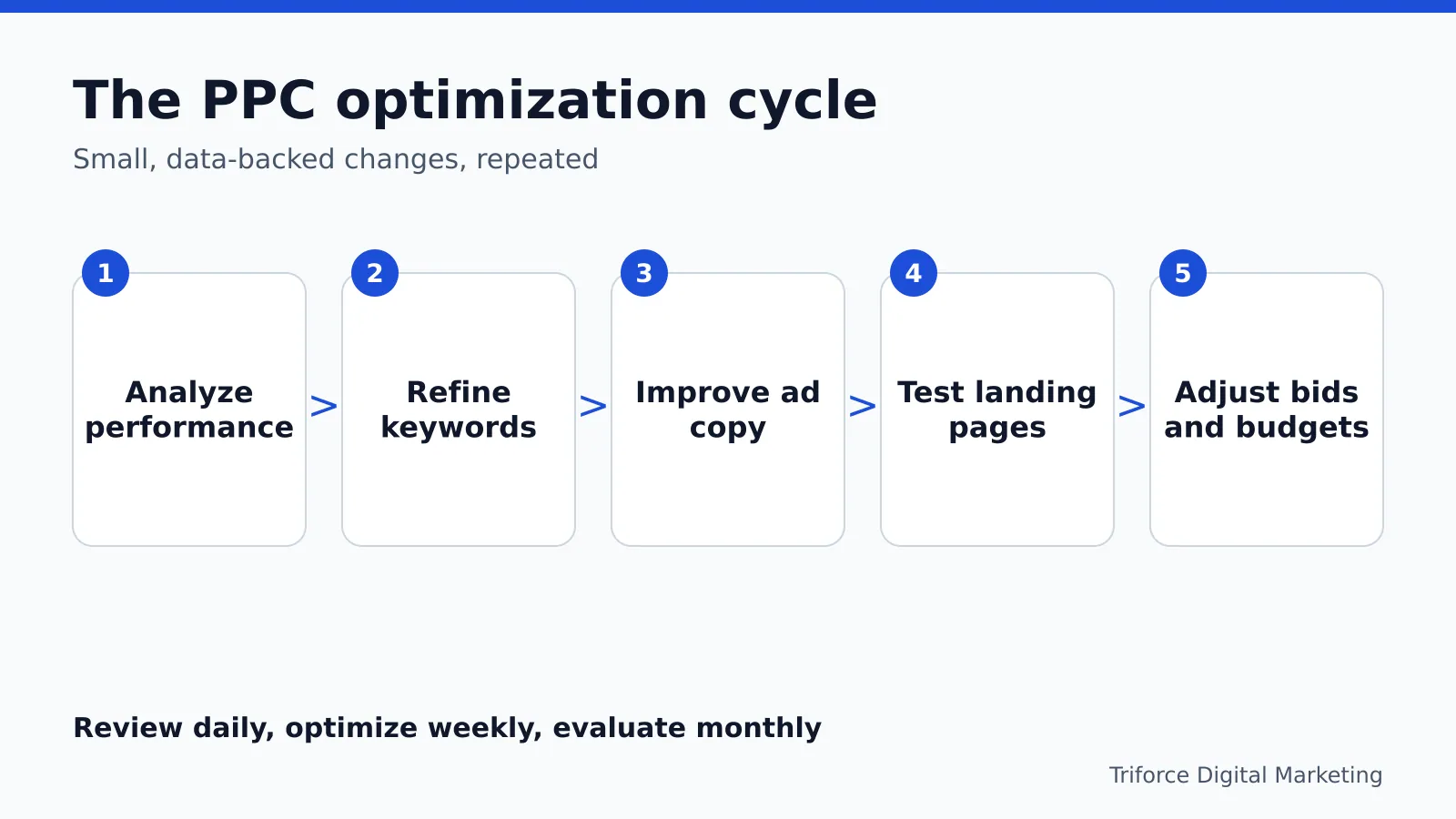
PPC optimization is the process of improving pay-per-click advertising campaigns to increase conversions, reduce advertising costs, and maximize return on investment (ROI). It involves analyzing campaign performance, refining keyword targeting, improving ad copy, adjusting bids, optimizing landing pages, and eliminating wasted ad spend. By continuously monitoring and improving these elements, businesses can attract more qualified visitors and generate better results from their advertising budgets.
For businesses investing in paid advertising, PPC optimization is essential for making every click count. Rather than simply increasing advertising spend to attract more traffic, an effective optimization strategy focuses on reaching the right audience, delivering relevant advertisements, and encouraging visitors to take meaningful action.
Pay-per-click (PPC) optimization refers to the ongoing process of evaluating and improving paid advertising campaigns to achieve specific marketing objectives. These objectives may include increasing website traffic, generating leads, driving product sales, receiving phone calls, or improving brand awareness.
PPC campaigns commonly run through advertising platforms such as Google Ads, Microsoft Advertising, and Meta Ads. Each platform offers different targeting options, bidding strategies, and campaign formats that advertisers can use to reach potential customers.
However, launching an advertisement does not automatically guarantee profitable results. Campaigns may attract irrelevant clicks, target overly broad keywords, experience low conversion rates, or spend too much on competitive search terms.
PPC optimization addresses these challenges by identifying underperforming campaign elements and making data-driven adjustments.
For example, a local business spending $1,000 per month on Google Ads may generate considerable website traffic but receive very few inquiries. Through PPC optimization, the business could refine its keyword targeting, improve its ad messaging, exclude irrelevant search terms, and create more effective landing pages. These improvements can help generate more qualified leads without necessarily increasing the advertising budget.
PPC advertising allows businesses to reach potential customers while they are actively searching for products or services. However, without proper optimization, advertising expenses can increase without producing meaningful business results.
Here are several reasons why PPC optimization is important.
One of the primary benefits of PPC optimization is reducing wasted advertising spend. Businesses can end up paying for clicks from users who have little interest in their offerings.
For example, a company providing professional plumbing services may accidentally target informational searches such as plumbing career opportunities or DIY plumbing tutorials.
By reviewing search term reports and adding negative keywords, advertisers can prevent their ads from appearing for irrelevant searches.
This helps direct more of the advertising budget toward searches that demonstrate genuine interest in the company’s services.
Generating clicks is only one part of a successful PPC campaign. Those clicks should ideally lead to meaningful actions, such as submitting a contact form, requesting a quote, making a purchase, or scheduling an appointment.
PPC optimization improves conversion opportunities by aligning keywords, advertisements, and landing pages with user intent.
For example, someone searching for emergency air conditioning repair is more likely to contact a business when the advertisement highlights emergency services, availability, and a clear phone number.
Improving this connection between the search query and the landing page can help turn more paid visitors into potential customers.
Return on investment is an important measurement of advertising effectiveness. Businesses want to know whether the revenue or value generated by their campaigns justifies the money spent.
PPC optimization helps improve ROI by identifying campaigns, keywords, and advertisements that produce the strongest results.
Rather than distributing the budget equally across every campaign, advertisers can allocate more resources to high-performing opportunities while reducing spending on underperforming areas.
Google Ads evaluates the relevance and quality of advertisements through its Quality Score system for eligible Search campaigns. Quality Score considers expected click-through rate, ad relevance, and landing page experience.
Improving these factors can contribute to better advertising performance and potentially lower costs per click.
For instance, an advertisement targeting a specific service should clearly communicate that service and direct users to a relevant landing page instead of a generic homepage.
PPC optimization allows businesses to refine who sees their advertisements.
Advertisers can evaluate geographic locations, devices, demographics, audience segments, and other available targeting signals depending on the platform and campaign type.
This is particularly valuable for businesses serving specific locations or customer groups.
A local restaurant, for example, may benefit from prioritizing nearby customers rather than spending its advertising budget reaching people outside its service area.
Businesses looking to strengthen their geographic visibility can also explore local marketing services as part of a broader digital marketing strategy.
Successful PPC optimization involves several interconnected campaign elements. Improving one area while neglecting the others may limit overall performance.
The following are some of the most important areas advertisers should evaluate.
Keyword research helps advertisers identify the search terms potential customers use when looking for products and services.
Choosing the right keywords is essential because they influence when advertisements appear and which audiences they reach.
During keyword optimization, advertisers should:
For example, a business offering digital marketing services may target keywords such as digital marketing agency, PPC management services, and Google Ads management.
Each keyword group should have advertisements that directly address the corresponding search intent.
Ad copy plays an important role in attracting attention and encouraging users to click.
Even when an advertisement appears for a relevant search, weak messaging may discourage potential customers from visiting the website.
Effective ad copy should communicate the value of the offering while addressing the user’s needs.
Consider the following elements when optimizing advertisements:
For example, instead of using a generic headline such as “Professional Marketing Services,” an advertiser could use “PPC Management Services That Drive Qualified Leads.”
The second headline communicates a more specific offering and gives potential customers a clearer reason to explore the advertisement.
Advertisers should also test different headlines, descriptions, and messaging approaches to determine which combinations perform best.
A landing page is where users arrive after clicking an advertisement. Its purpose is to encourage visitors to complete a desired action.
A poorly designed landing page can waste advertising spend even when the campaign generates relevant traffic.
Important landing page optimization considerations include:
For example, an advertisement promoting PPC management should direct visitors to a dedicated PPC service page rather than a general homepage.
Businesses can further improve landing page performance through conversion rate optimization (CRO), which focuses on identifying barriers and increasing the percentage of visitors who complete desired actions.
Bid optimization involves adjusting how much an advertiser is willing to pay for advertising opportunities.
Advertising platforms provide different bidding strategies depending on campaign objectives, available conversion data, and budget requirements.
Common Google Ads bidding strategies include:
The appropriate bidding strategy depends on campaign goals and data quality.
For example, an eCommerce business with reliable purchase tracking may benefit from conversion value-based bidding. Meanwhile, a service business focused on lead generation may prioritize qualified form submissions or phone calls.
Advertisers should regularly evaluate bidding performance instead of assuming that one strategy will remain effective indefinitely.
Negative keywords prevent advertisements from appearing for searches that are unrelated to the products or services being promoted.
This is particularly important for campaigns using broad or phrase matching because they may attract searches that do not align with business objectives.
For example, a company selling premium office furniture may want to exclude searches containing terms such as free, used, DIY, or jobs, depending on its offerings and campaign goals.
Regularly reviewing search term reports helps advertisers discover irrelevant queries and identify opportunities to refine their keyword targeting.
Effective negative keyword management can reduce wasted clicks and help maintain campaign relevance.
Not every potential customer is equally valuable to a business. Audience and geographic targeting help advertisers focus their campaigns on people who are more likely to become customers.
For local businesses, geographic targeting is particularly important.
A dental practice serving Richardson, Texas, for example, may prioritize nearby communities rather than targeting users across the entire United States.
Advertisers should evaluate:
Businesses can combine paid advertising with local SEO services to strengthen their visibility in geographically relevant searches.
A successful PPC campaign should not rely on a single advertisement or messaging approach.
Testing allows advertisers to compare different creative elements and identify opportunities for improvement.
Common testing opportunities include:
Advertisers should use platform-supported experiments or controlled testing methods whenever possible. Changing too many campaign elements simultaneously can make it difficult to identify which adjustment influenced performance.
PPC optimization requires consistent performance monitoring. Advertisers should evaluate metrics that reflect both advertising efficiency and actual business outcomes.
Here are some of the most important PPC metrics to track.
| Metric | What It Measures | Why It Matters |
|---|---|---|
| Impressions | Number of times an ad appears | Measures advertising visibility |
| Clicks | Number of times users click an ad | Measures traffic generation |
| Click-Through Rate (CTR) | Percentage of impressions that generate clicks | Helps evaluate ad relevance and appeal |
| Cost Per Click (CPC) | Average amount paid per click | Measures traffic acquisition costs |
| Conversion Rate | Percentage of clicks that result in conversions | Measures campaign effectiveness |
| Cost Per Acquisition (CPA) | Average cost of generating a conversion | Helps evaluate acquisition efficiency |
| Return on Ad Spend (ROAS) | Revenue generated for every dollar spent on advertising | Measures advertising revenue efficiency |
| Quality Score | Google’s diagnostic rating of keyword quality | Helps identify areas for improvement |
Cost per acquisition and return on ad spend are particularly important when evaluating PPC profitability.
CPA measures how much a business spends to generate a conversion.
For example, if a company spends $1,000 and receives 20 leads, its cost per lead is $50.
ROAS measures how much revenue an advertising campaign generates relative to its advertising expenses.
If an eCommerce campaign spends $1,000 and generates $5,000 in attributed revenue, its ROAS is 5:1.
However, a strong ROAS does not automatically mean a campaign is profitable. Businesses should also account for product costs, operating expenses, fulfillment, and other overhead.
For lead generation campaigns, advertisers should ideally track qualified leads and closed sales rather than relying exclusively on form submissions.
PPC optimization is an ongoing process rather than a one-time activity. The appropriate review frequency depends on campaign size, advertising spend, competition, and conversion volume.
A practical optimization schedule may include:
Advertisers should avoid making unnecessary adjustments based on limited data. Campaign changes should be supported by sufficient performance information and aligned with specific business objectives.
Even experienced advertisers can make mistakes that negatively affect campaign performance.
Here are some common issues businesses should avoid:
PPC optimization is most effective when it supports a broader digital marketing strategy.
Although paid advertising can generate immediate visibility, other marketing channels can help businesses build long-term online presence, strengthen credibility, and reach customers at different stages of the buying journey.
For example, combining PPC with search engine optimization (SEO) allows businesses to pursue both paid and organic search visibility.
SEO helps websites attract unpaid traffic through relevant content, technical improvements, and search engine visibility. PPC provides opportunities to reach users through sponsored placements.
Businesses can also incorporate content marketing to provide useful information that supports customers throughout their decision-making process.
Meanwhile, email marketing can help nurture leads who are not yet ready to purchase.
An integrated approach allows businesses to use different marketing channels to support customer acquisition, engagement, and retention.
Managing PPC campaigns requires ongoing research, monitoring, testing, and optimization. While business owners can manage their own advertisements, working with an experienced PPC management agency can help streamline campaign operations and identify opportunities for improvement.
A professional agency can assist with:
When evaluating an agency, consider its experience, reporting process, communication, and ability to connect advertising performance with actual business objectives.
You can learn more about what to expect from a PPC management agency before deciding which provider is right for your business.
Triforce also offers pay-per-click management services designed to help businesses improve their paid advertising efforts and reach potential customers more effectively.
To learn more about the company’s approach and experience, visit the Triforce team page or explore its client testimonials.
PPC optimization helps businesses get more value from their advertising budgets by improving keyword targeting, ad relevance, bidding strategies, landing pages, and conversion tracking. Consistent monitoring and data-driven adjustments allow campaigns to become more efficient and generate better business results over time.
Whether you are launching your first campaign or improving an established advertising strategy, focusing on qualified traffic and measurable conversions is essential.
Ready to improve your paid advertising performance? Explore Triforce’s digital marketing services or request a free SEO analysis to start strengthening your online marketing strategy.
We will review your campaigns, find where budget is leaking, and show you the data behind every move. Book a Free Strategy Session with Triforce and talk through your next step.
So, how long does PPC take? PPC advertising can start generating traffic and clicks within
A PPC audit is a comprehensive evaluation of a pay-per-click advertising campaign to identify performance

A PPC curve shifts outward when a campaign gets more results from the same budget.