Cart 0


How Long Does PPC Take?
So, how long does PPC take? PPC advertising can start generating traffic and clicks within
A PPC audit is a comprehensive evaluation of a pay-per-click advertising campaign to identify performance issues, eliminate wasted advertising spend, and uncover opportunities to improve results. To conduct a PPC audit, businesses should review campaign settings, keyword targeting, ad copy, bidding strategies, audience targeting, conversion tracking, landing pages, and overall advertising performance. By examining these areas, advertisers can determine what is working, what needs improvement, and how to allocate their budgets more effectively.
Whether you manage Google Ads campaigns yourself or work with a digital marketing agency, conducting regular PPC audits helps ensure that advertising efforts remain aligned with business goals. A structured audit also provides actionable insights that can improve campaign efficiency, generate qualified leads, and maximize return on advertising spend.
A PPC audit is a detailed assessment of paid advertising campaigns to evaluate their effectiveness, identify weaknesses, and recommend improvements.
It examines different campaign components, including account structure, keyword selection, advertisements, bidding strategies, targeting settings, conversion tracking, and landing page performance.
The primary purpose of a PPC audit is to determine whether advertising campaigns are generating meaningful business results relative to their costs.
For example, a business may spend $2,000 per month on Google Ads but receive only a small number of qualified inquiries. An audit can reveal whether the problem comes from irrelevant keywords, poor ad messaging, ineffective landing pages, inaccurate conversion tracking, or inefficient budget allocation.
Rather than increasing advertising spend immediately, businesses can use audit findings to identify and correct existing problems.
A PPC audit is also an important part of ongoing pay-per-click management because campaign performance can change as competition, customer behavior, and advertising costs evolve.
Running advertisements without regularly evaluating their performance can lead to unnecessary expenses and missed opportunities. A PPC audit helps businesses understand how effectively their advertising budget is being used.
Here are several reasons why conducting a PPC audit is important.
One of the biggest challenges in PPC advertising is paying for clicks that do not generate meaningful results.
Campaigns may attract visitors searching for unrelated products, informational resources, employment opportunities, or services that a business does not provide.
A PPC audit identifies these issues by reviewing search term reports, keyword performance, geographic targeting, and audience data.
By excluding irrelevant searches and adjusting targeting settings, advertisers can focus their budgets on more valuable opportunities.
An audit helps identify advertisements, keywords, and campaigns that are underperforming.
For example, an advertisement may receive thousands of impressions but generate very few clicks. This could indicate that its messaging is not relevant or compelling enough for the intended audience.
Similarly, a campaign with a high click-through rate but a low conversion rate may have a landing page or conversion experience problem.
Identifying these weaknesses helps advertisers make improvements based on actual performance data.
Businesses need to understand whether their advertising investments are generating sufficient value.
A PPC audit evaluates metrics such as cost per click (CPC), cost per acquisition (CPA), conversion rate, and return on ad spend (ROAS).
These measurements help businesses identify which campaigns generate the strongest results and which ones require adjustments.
Accurate conversion tracking is essential for evaluating PPC performance.
If Google Ads records incorrect conversions, misses important actions, or counts duplicate events, advertisers may make decisions based on unreliable information.
A PPC audit helps verify that conversion tracking is properly configured and that campaign reports reflect meaningful business activities.
An audit is not only about finding problems. It can also reveal opportunities to expand successful campaigns.
For example, advertisers may discover high-converting search terms that are not being targeted directly, geographic areas generating valuable leads, or landing pages that perform better than others.
These insights can support future campaign expansion and budget planning.
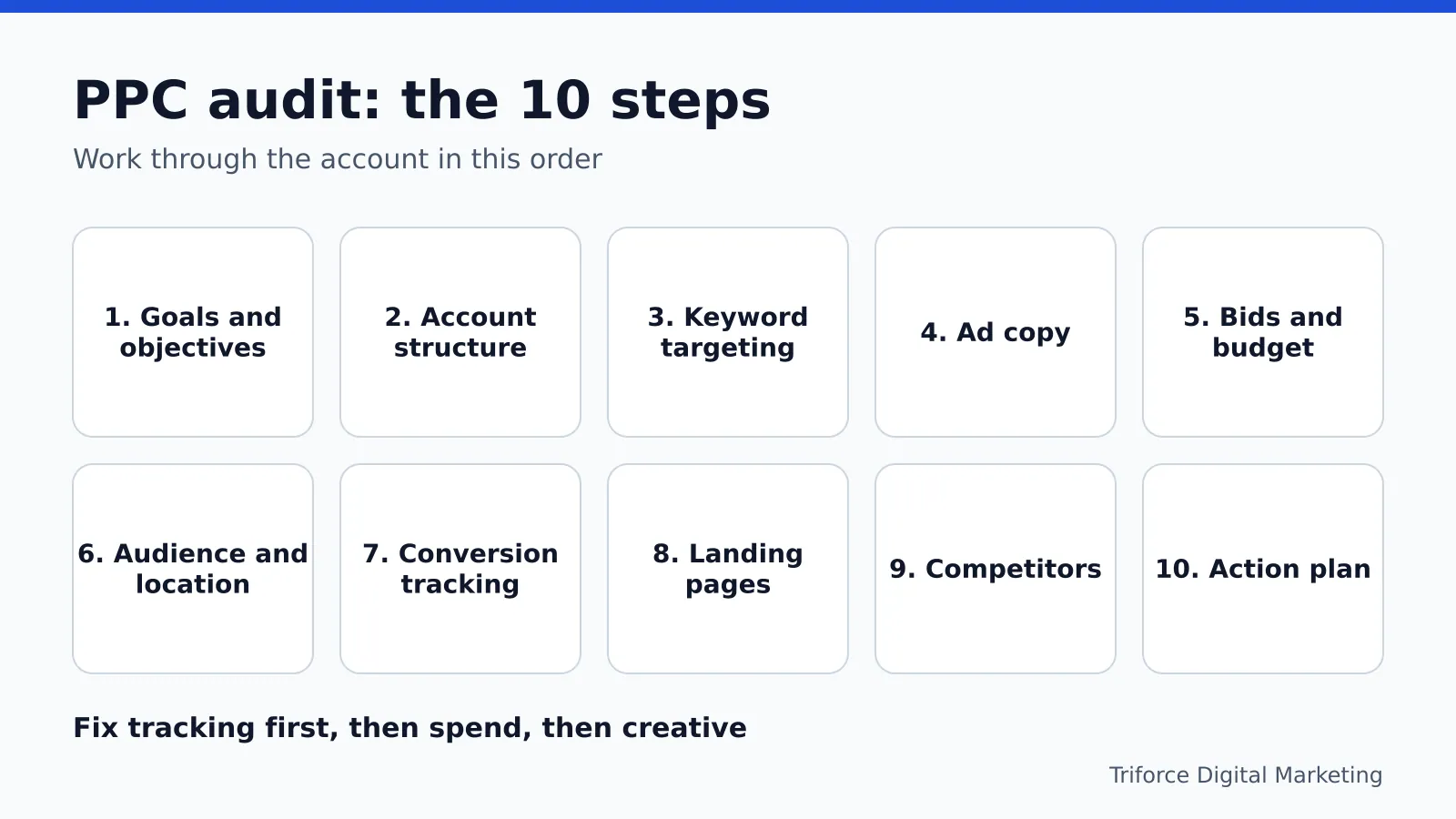
A successful PPC audit should follow a structured process. Reviewing each campaign component individually makes it easier to identify problems and prioritize improvements.
Below are ten essential steps for conducting a comprehensive PPC audit.
Before examining campaign settings or performance metrics, determine what the advertising campaigns are intended to accomplish.
Different businesses have different PPC objectives. Some focus on generating leads, while others prioritize online purchases, phone calls, appointment bookings, or brand awareness.
Review the following:
For example, an eCommerce business may prioritize purchases and revenue, while a local service provider may focus on qualified inquiries and phone calls.
Establishing clear objectives provides a foundation for evaluating campaign performance.
An advertisement generating 100 clicks but no qualified leads may be underperforming for a lead generation business, even if its traffic volume looks impressive.
A well-organized advertising account makes campaigns easier to manage, monitor, and optimize.
During this step, review how campaigns and ad groups are organized.
Check whether:
For example, a digital marketing agency offering SEO, PPC, and social media management may benefit from separate campaigns for each service.
This structure allows advertisers to create more relevant advertisements and direct users to dedicated service pages.
Avoid creating unnecessarily complicated account structures. The objective is to make campaigns organized enough to support effective management without creating excessive administrative work.
Keyword targeting directly influences which searches trigger your advertisements.
An effective PPC audit should examine whether selected keywords are relevant to the products or services being promoted.
Review the following keyword elements:
Keyword Relevance: Determine whether targeted keywords accurately represent the business’s offerings.
Search Intent: Identify whether keywords indicate informational, commercial, or transactional intent.
Match Types: Review broad match, phrase match, and exact match settings to understand how closely searches align with targeted keywords.
Keyword Performance: Evaluate impressions, clicks, CPC, conversions, and CPA for individual keywords.
Negative Keywords: Identify irrelevant searches that should be excluded.
For example, a company providing professional PPC management may target keywords such as:
However, searches related to free advertising courses or PPC jobs may not be relevant to its customer acquisition goals.
Reviewing search term reports is particularly important because the actual queries triggering advertisements may differ from the keywords advertisers originally selected.
You should also identify high-performing search terms that could become additional targeted keywords.
Even with appropriate keyword targeting, poorly written advertisements can limit campaign performance.
During the audit, review whether advertisements communicate the right message and encourage users to take action.
Evaluate:
For example, an advertisement promoting professional web design should clearly communicate its services and provide a compelling reason for users to visit the website.
Compare advertisements to identify which messaging approaches generate stronger engagement and conversions.
Also check for disapproved advertisements, outdated promotional offers, broken URLs, and missing assets.
Google Ads responsive search ads allow advertisers to provide multiple headlines and descriptions that the platform can combine. Review their performance and asset ratings as diagnostic information, but avoid relying on asset ratings alone to determine actual business results.
Your bidding strategy determines how advertising platforms participate in available ad auctions and optimize campaign delivery.
An audit should evaluate whether the selected bidding strategy supports the campaign’s objectives.
Common Google Ads bidding strategies include:
Review the following:
For example, if one campaign consistently generates qualified leads at a lower CPA than another, it may deserve a larger share of the advertising budget.
However, budget changes should consider lead quality, conversion value, available search demand, and business capacity.
You should also understand the concept of diminishing returns. Increasing advertising spend does not always produce proportional increases in conversions. Learn more about this through Triforce’s guide to the PPC curve and diminishing returns.
Audience and geographic targeting help advertisers reach potential customers who are more likely to engage with their business.
During the audit, review whether campaigns are targeting the correct locations and audience segments.
Check:
For local businesses, geographic targeting deserves particular attention.
For example, a plumbing company operating in Richardson, Texas, may not benefit from spending its advertising budget targeting users in unrelated states.
Review location reports to determine where clicks, leads, and conversions originate.
You should also verify whether location settings match the business’s actual service coverage.
Businesses that want to strengthen their visibility in specific geographic markets can combine paid advertising with local SEO services.
Conversion tracking is one of the most important parts of a PPC audit because it determines how campaign success is measured.
Without accurate tracking, advertisers cannot reliably identify which campaigns generate valuable actions.
Review your Google Ads conversion actions and associated tracking setup.
Important conversion actions may include:
Check whether:
For example, if a business receives 30 contact form submissions but Google Ads reports 60 conversions, there may be a tracking issue that needs investigation.
It is also important to distinguish between total leads and qualified leads.
A campaign generating many low-quality inquiries may be less valuable than one generating fewer inquiries that consistently become paying customers.
Use Google Analytics 4 and Google Ads reports together to understand user behavior and advertising outcomes.
Landing pages have a direct influence on what happens after someone clicks an advertisement.
Even a well-targeted campaign can produce poor results if visitors encounter confusing messaging, slow loading times, or difficult navigation.
Review each major landing page and evaluate the following:
Content Relevance: Does the page clearly address the advertisement and search query?
Headline Quality: Does the headline communicate the main offering?
Calls to Action: Are buttons, contact information, and forms easy to find?
Mobile Responsiveness: Does the page work properly on smartphones and tablets?
Page Speed: Does the page load quickly enough to provide a good experience?
Trust Signals: Are testimonials, reviews, credentials, and other relevant trust elements displayed?
Navigation: Can visitors easily find the information they need?
For example, a PPC campaign promoting SEO services should direct visitors to a relevant SEO landing page rather than an unrelated service page.
You can also improve campaign performance by applying conversion rate optimization strategies to identify and remove barriers that prevent visitors from converting.
PPC performance is influenced by competition, advertising demand, and changes in customer behavior.
A comprehensive audit should examine how competitors participate in the same advertising market.
Use available Google Ads Auction Insights data to evaluate:
These metrics help advertisers understand how frequently competitors appear in the same auctions and how their visibility compares.
You can also review competitor messaging, promotional offers, landing page experiences, and service positioning.
However, competitor analysis should not result in blindly copying another advertiser’s strategy.
Instead, identify opportunities to differentiate your business through clearer messaging, stronger offers, more relevant landing pages, and better audience targeting.
The final step is turning audit findings into actionable improvements.
An audit without a clear implementation plan provides limited value.
Organize identified issues according to their potential impact, urgency, and implementation effort.
For example:
| Audit Finding | Recommended Action | Priority |
|---|---|---|
| Irrelevant search queries | Add negative keywords | High |
| Incorrect conversion tracking | Fix and validate tracking | Critical |
| Low-performing ad copy | Test improved headlines and descriptions | Medium |
| Poor landing page conversion rate | Improve content and calls to action | High |
| Budget concentrated on weak campaigns | Review and redistribute spending | High |
| Incorrect geographic targeting | Refine location settings | High |
| Outdated advertisements | Update messaging and offers | Medium |
| Poor mobile experience | Improve mobile usability and speed | High |
Prioritize issues that directly affect measurement accuracy, advertising costs, and conversion opportunities.
After implementing changes, establish a monitoring schedule to evaluate whether the adjustments produce the expected improvements.
Using the right tools makes it easier to collect performance data, identify campaign problems, and develop actionable recommendations.
Here are several tools that can support the PPC auditing process.
| Tool | Primary Purpose |
|---|---|
| Google Ads | Campaign performance, keywords, bidding, search terms, and conversion tracking |
| Google Analytics 4 | Website traffic, user behavior, and conversion analysis |
| Google Tag Manager | Managing and testing website tracking tags |
| Google Search Console | Understanding organic search visibility and identifying opportunities across search channels |
| Google PageSpeed Insights | Evaluating page performance and loading experience |
| Microsoft Advertising | Reviewing and auditing Microsoft Ads campaigns |
| Google Keyword Planner | Keyword research, search estimates, and advertising forecasts |
| Looker Studio | Creating campaign performance dashboards and reports |
Each tool provides different information. Combining these resources allows advertisers to evaluate campaign performance from multiple perspectives.
For businesses managing several marketing channels, digital consultancy services can also help align advertising activities with broader business objectives.
The frequency of PPC audits depends on campaign complexity, advertising spend, competition, and performance stability.
However, businesses should establish a consistent review schedule.
Businesses should also conduct an audit whenever they experience significant performance changes, launch new campaigns, change their website, or introduce new products and services.
While conducting a PPC audit, avoid these common mistakes that can lead to inaccurate conclusions or ineffective recommendations.
Traffic metrics provide useful information, but they do not necessarily indicate business success. Evaluate conversions, lead quality, and revenue where applicable.
Incorrect tracking can make successful campaigns appear unsuccessful and underperforming campaigns appear profitable. Validate tracking before making major decisions.
Making several changes simultaneously makes it difficult to determine which adjustment influenced performance. Prioritize changes and monitor their individual impact when practical.
A keyword with a high CPC is not automatically unprofitable. Consider its conversion rate, lead quality, and contribution to overall business results.
An audit should evaluate the complete customer journey, not just the advertisements. Landing page problems can significantly affect campaign results.
Without proper documentation, businesses may repeat previous mistakes or lose track of implemented improvements. Maintain an audit report that records findings, recommendations, priorities, and results.
Businesses can conduct PPC audits internally, particularly when they have access to advertising accounts, analytics platforms, and experienced campaign managers.
However, managing a comprehensive audit requires time, technical knowledge, and the ability to interpret advertising data correctly.
Working with an experienced agency can provide additional support through:
When choosing an agency, evaluate its experience, reporting practices, communication process, and ability to connect advertising performance with measurable business outcomes.
You can explore what to expect from a PPC management agency to better understand the services and support involved.
Triforce provides PPC management services to help businesses manage their paid advertising campaigns and improve their digital marketing performance.
Businesses can also explore Triforce’s digital marketing services to learn how paid advertising can work alongside other marketing strategies.
A PPC audit helps businesses identify wasted advertising spend, improve campaign targeting, validate conversion tracking, and uncover opportunities to generate better results. By regularly reviewing campaign performance and prioritizing data-driven improvements, businesses can make more informed advertising decisions.
Whether managing campaigns internally or working with an agency, a structured PPC audit is an important step toward building more efficient and results-driven advertising campaigns.
Ready to improve your PPC performance? Explore Triforce’s PPC management services or contact the team to discuss your digital advertising goals.
We will walk through your account with you, find the wasted spend, and show you the data behind every fix. Book a Free Strategy Session with Triforce and talk through your next step.
So, how long does PPC take? PPC advertising can start generating traffic and clicks within
PPC optimization is the process of improving pay-per-click advertising campaigns to increase conversions, reduce advertising

A PPC curve shifts outward when a campaign gets more results from the same budget.