Cart 0

How Long Does PPC Take?
So, how long does PPC take? PPC advertising can start generating traffic and clicks within

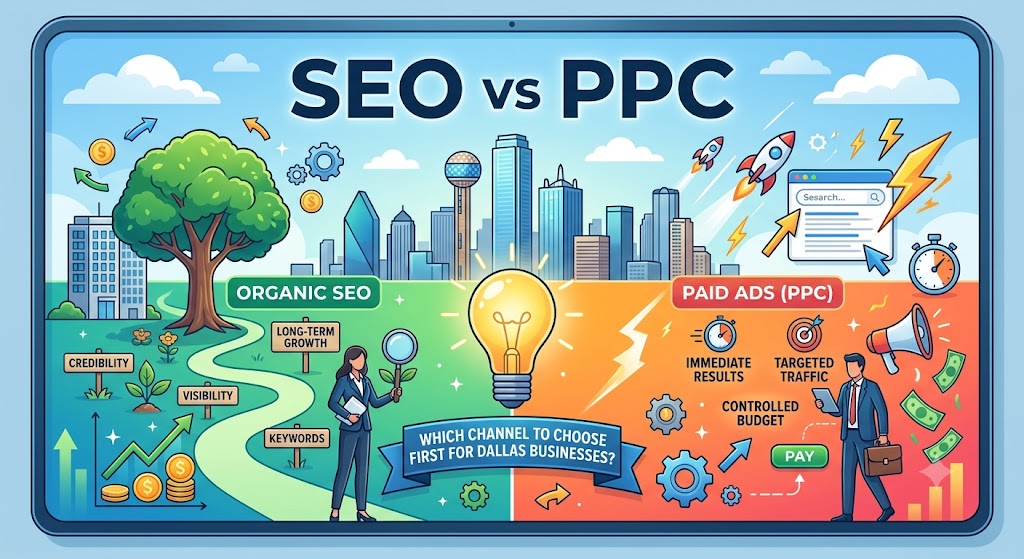
When our clients ask us which should come first – SEO or PPC – more often than not, the true answer is that neither of those should come first until the client understands what both of them are and do.
Here is a quick and simple explanation.
SEO helps get you higher in organic search results. If someone in Dallas does a search for “roofing contractors near me” or “pediatric dentist Plano TX,” and your website shows up without the “ad” tag next to it, that’s because of SEO.
The catch is time. Good SEO generally takes from four to nine months before showing some results in rankings. Domain authority building, good link building, and creating content that Google will trust take time.
What SEO gives you in return for that patience is durable, compounding traffic. A page that ranks on page one today keeps driving leads next year without an ongoing cost per click. The margin on that traffic improves over time because you are not paying every time someone clicks.
For established Dallas businesses with a functional website and a medium-term growth plan, SEO services in Dallas are often the highest-ROI channel in the portfolio once they kick in.
Pay per click, such as Google Ads, Microsoft Ads, and Meta Ads, makes your company known to customers at once. You create an ad campaign, set a budget and launch it. In return, you have to pay for each click, and as soon as you cease paying, you go out of visibility.
For time-sensitive businesses, PPC is the right call. A seasonal service, a new product launch, a local business entering a new market these cannot wait nine months. PPC gives you traffic on day one.
The challenge is economics. In competitive Dallas markets law, dentistry, home services, financial services average Google Ads CPCs run $15 to $60 or more per click. If your conversion rate is 3% and you are paying $30 per click, that is roughly $1,000 per acquisition. That is not a dealbreaker, but it requires you to know your numbers: lifetime customer value, close rate, profit margin before you commit budget.
Our PPC management in Dallas keeps cost-per-acquisition in line by matching spend to the right keywords, not just the highest-volume ones. Done poorly, paid search burns through budget with nothing to show.
The honest comparison is not about which channel is better. It is about what stage your business is at and what outcome you are optimizing for.
SEO: Fixed monthly investment, results in 4–9 months, traffic persists when you pause spending, best for long-term brand authority and compounding leads.
PPC: Cost-per-click model, results in days, traffic stops the moment you pause, best for fast lead flow, seasonal campaigns, and rapid market testing.
The difference between SEO and PPC also shows up in intent capture. Search ads intercept people already in buying mode; someone who typed “emergency plumber Dallas” needs someone now. SEO content captures that same person, but it can also reach buyers earlier in the process: someone researching what a service costs, comparing providers, or figuring out whether they need what you offer at all.
Organic search, according to the Google Search Essentials guide, continues to be one of the most effective means of discovering new customers across all industries, and this gets amplified as your domain authority increases – something that paid traffic cannot achieve.
Running both channels is not just about occupying more search result real estate. The data integration is where the actual advantage lives.
PPC tells you quickly and with statistical confidence which keywords convert, what ad copy drives clicks, and which landing pages close leads. That data is expensive and slow to gather through organic content, which requires months of ranking before you get meaningful volume.
SEO tells you over time which content builds authority, which topics earn backlinks, and which pages keep people engaged long enough to convert. That signal is hard to get from PPC because paid traffic behavior differs from organic intent.
The best Dallas digital marketing agencies use both signals together: run paid to get data fast, build organic content around what the data confirms, and reduce paid dependence as organic authority scales. Our digital marketing services in Dallas connect both channels under a unified strategy so neither runs blind.
The most common mistake we see is choosing one channel based on what someone heard at a networking event, then going all-in without measuring anything.
SEO without measurement is guessing. You do not know which pages are ranking, which keywords are driving traffic, or which content is converting. Without that data, you are publishing blog posts into the void and hoping something lands.
PPC without measurement is burning money. If you are not tracking phone call conversions, form submissions, and cost-per-acquisition by campaign and keyword group, you have no idea whether you are profitable, only whether the clicks are coming in.
Before committing to either channel- or both- you need baseline tracking in place: Google Analytics 4, Google Search Console, and call tracking at minimum. Without those, neither SEO nor PPC can be managed with any intelligence.
For those of you in the Dallas area who want to know whether SEO is better than PPC or how to do both without blowing half your money, the solution lies within your timeframe, margins, and goals for the next year.
We work with businesses across the DFW Metroplex on both channels, and we have seen what actually drives results in competitive local markets. Schedule a free consultation with our team, and we will tell you exactly which approach fits your situation no oversell, just a straight answer.
You can also read more about what to look for in a Google Ads management agency in Dallas, or learn what real SEO services in Dallas should deliver before you sign with anyone.
A: The reason why using SEO right away is a risky move is that it usually takes at least four to nine months to establish good ranking results through organic search. Since new companies require quick lead generation, PPC is crucial on day one.
How much budget should I allocate to PPC before seeing a return?
A: PPC advertising relies heavily on local market competition and cost per click. For competitive markets such as Dallas in the home services sector or the legal sector, make sure that your budget allows you to comfortably buy a sufficient number of clicks for your website conversion rates.
Does running PPC ads directly help improve my organic SEO rankings?
A: PPC does not help in improving the ranking of a website organically, but the two work wonderfully together. With PPC, you get immediate results on what keywords can convert for you, hence helping you build an SEO strategy for content going forward.
What happens to my web traffic if I suddenly pause my SEO campaign?
A: Unlike PPC, where traffic stops the moment you turn off the budget, organic traffic from SEO persists. A well-ranked page keeps driving compounding leads over time, meaning your overall cost per acquisition improves steadily the longer the content performs.
Is it better to hire two different agencies for SEO and PPC?
A: It is usually better to hire one unified agency. Combining SEO and PPC under a single team ensures your conversion data, keyword insights, and overall digital marketing strategy sync up seamlessly, preventing your campaigns from working against each other.
So, how long does PPC take? PPC advertising can start generating traffic and clicks within
A PPC audit is a comprehensive evaluation of a pay-per-click advertising campaign to identify performance
PPC optimization is the process of improving pay-per-click advertising campaigns to increase conversions, reduce advertising
The Triforce Digital Marketing team combines expertise in SEO, paid advertising, social media, content, web development, and AI-powered marketing to help businesses increase visibility, generate qualified leads, improve conversions, and achieve measurable growth.
Please Check Your Inbox to Download the Resource!