Cart 0




What Is CRM Integration? A Complete Guide for Businesses
CRM integration connects your customer relationship management system with other business tools so data flows

If you’re deciding where to put your marketing budget, the SEO vs. PPC question comes up fast. Both strategies drive traffic from search engines, both can generate leads, and both cost real money. The difference is how they work, how quickly they deliver results, and what they cost you over time. This guide breaks down both approaches so you can decide what makes sense for your business — or whether you should be using both.
Triforce offers both SEO services and PPC management for businesses across Dallas and Texas. If you want to talk through the right mix, schedule a free consultation here.
SEO, or search engine optimization, is the process of improving a website so it can appear more prominently in organic search results. Instead of paying for every click, businesses optimize their website, content, technical structure, and online presence to increase their chances of ranking for relevant searches — without paying per visitor.
SEO involves keyword research and targeting, on-page optimization, technical SEO, content creation, internal linking and website structure, local SEO, link building, search intent optimization, and website performance and speed.
Businesses looking to improve their organic visibility can learn more about search engine optimization services and how SEO fits into a broader digital strategy.
PPC stands for pay-per-click advertising — a form of paid digital advertising where advertisers pay when someone clicks on an advertisement. PPC ads appear prominently on search engine results pages when users search for targeted keywords, and on other platforms and channels depending on campaign objectives.
For businesses that want to generate traffic quickly, PPC management can be an important part of their digital marketing strategy.
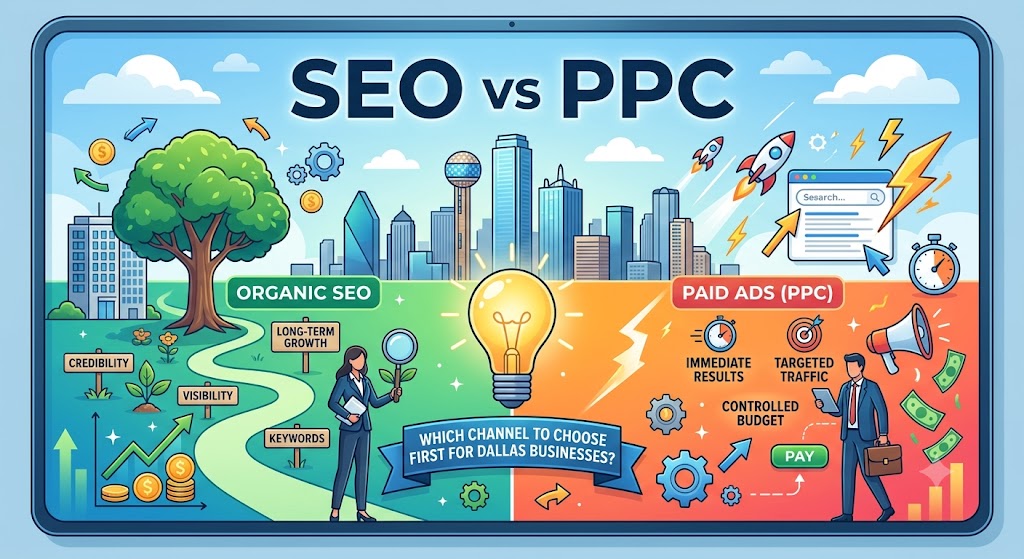
The biggest difference between SEO and PPC is how a business earns visibility in search results. With SEO, you work to earn organic rankings — a visitor clicks an organic result without the business paying a direct fee for that click. With PPC, you pay to place advertisements in front of users who match specific targeting criteria, and you’re charged per click.
As Moz explains, SEO is fundamentally a long-term investment in organic visibility, while PPC is designed to generate immediate paid traffic. Both have distinct roles in a healthy search marketing strategy.
| Factor | SEO | PPC |
|---|---|---|
| Traffic source | Organic | Paid |
| Initial results | Usually slower | Usually faster |
| Cost model | Investment in optimization and content | Typically pay per click |
| Long-term value | Can continue generating traffic after optimization | Traffic generally stops when campaigns stop |
| Targeting | Based on relevance, content, authority, and ranking factors | Detailed audience, keyword, location, device targeting |
| Best for | Sustainable organic visibility | Immediate targeted traffic |

PPC generally produces results faster than SEO. Once a properly configured PPC campaign is approved and running, advertisements can begin appearing for relevant searches. This makes PPC particularly useful when a company needs traffic, leads, or sales within a relatively short timeframe.
SEO usually requires more patience. A website may need improvements to its technical foundation, content, authority, relevance, and overall search presence before significant ranking improvements occur. That doesn’t mean SEO is ineffective — it means SEO and PPC operate on different timelines. A new business launching a service could use PPC to generate immediate visibility while simultaneously developing an SEO strategy designed to build organic traffic over the long term.
There’s no universal answer. PPC requires an advertising budget with variable click costs that depend on keyword, industry, competition, location, and platform. SEO doesn’t mean “free traffic” — effective SEO requires investment in strategy, content, technical improvements, link acquisition, website development, tools, and ongoing optimization.
The right question isn’t which costs less — it’s which produces the better cost of acquiring a customer or qualified lead. A PPC campaign that generates highly profitable customers may be worthwhile even when clicks are expensive. An SEO strategy that consistently generates qualified organic traffic creates significant long-term value.
SEO often has an advantage when the primary goal is building sustainable search visibility. A successful SEO strategy can help a website rank for numerous related searches. Once pages establish strong organic visibility, they may continue attracting visitors without requiring the business to pay for each individual click. Content can compound over time — a well-optimized service page may rank for multiple related keywords, while supporting content attracts users earlier in the buying journey.
However, SEO requires ongoing maintenance. Search behavior changes, competitors publish new content, search engines update their systems, and websites evolve. Treat SEO as an ongoing process, not a one-time project.
PPC is often better suited to businesses that need immediate visibility. A company launching a new service can put its offer in front of relevant searchers right away rather than waiting for organic rankings. PPC is also useful for new product launches, seasonal promotions, limited-time offers, new service areas, lead-generation campaigns, and testing commercial keywords before committing to a longer-term strategy.
One major advantage of PPC is the ability to collect performance data quickly. A PPC campaign can determine which keywords generate clicks, leads, and conversions — and those insights can directly inform the SEO strategy. If paid search data shows that a particular keyword generates qualified leads, it may deserve greater attention in the organic content strategy. This makes SEO and PPC complementary rather than competing channels.
Local businesses can benefit from both strategies. SEO helps improve visibility for searches with local intent through optimized service pages, location information, and local content. PPC provides another way to reach potential customers in specific geographic areas.
For a company serving the Dallas-Fort Worth area, combining organic local visibility with geographically targeted advertising provides broader coverage throughout the customer journey. Our local SEO services and PPC management work together to maximize your presence across both channels.
Yes — and often they should. Instead of asking whether SEO or PPC should be used exclusively, the better question is how each channel should contribute to your overall customer acquisition process.
SEO provides long-term organic visibility, educational content, service-page rankings, and consistent organic traffic. PPC provides immediate visibility, targeted traffic, promotional opportunities, keyword testing, and rapid campaign adjustments. A business could use PPC to generate immediate leads while its SEO campaign builds organic rankings. Over time, organic traffic may reduce reliance on paid traffic for some searches, while PPC continues supporting competitive keywords and high-value campaigns.
Choose SEO if: you want long-term organic traffic, you’re building sustainable online visibility, you can invest in a longer-term strategy, you want to build topical authority, or you want to reduce dependence on paid traffic over time.
Choose PPC if: you need traffic quickly, you’re launching a new product or service, you have a defined advertising budget, you want to test commercial keywords, or you’re promoting a limited-time offer.
Consider both if: you want immediate and long-term traffic, you operate in a competitive market with sufficient resources for both, or you want PPC data to inform SEO decisions and appear in multiple search positions.
One common mistake is assuming one channel should completely replace the other. Another is judging SEO based only on short-term performance — SEO requires time to build momentum. Other common mistakes include targeting keywords without considering search intent, sending all traffic to the homepage, ignoring landing-page quality, failing to track conversions, stopping SEO too early, running PPC without clear objectives, and measuring traffic without measuring business outcomes.
SEO and PPC are only two components of digital marketing. Businesses may also need content marketing, email marketing, social media, website development, reputation management, local marketing, and conversion optimization. A visitor might discover a company through an organic search result, return later through a PPC advertisement, subscribe through an email campaign, and eventually become a customer after visiting a well-designed service page.
A full-service digital marketing strategy incorporates multiple channels depending on a company’s goals, audience, and market — rather than treating each channel in isolation.
Is SEO better than PPC?
Neither is universally better. SEO focuses on long-term organic visibility while PPC generates paid visibility more quickly. The better option depends on your goals, budget, timeline, and competition.
Is PPC better than SEO for new businesses?
PPC can generate visibility faster, making it useful for new businesses. But investing in SEO early also pays off by building organic visibility over time. Many new businesses do both.
Can SEO reduce PPC costs?
SEO may reduce reliance on paid traffic for searches where the website earns strong organic rankings. However, SEO doesn’t necessarily eliminate the need for PPC, particularly for competitive searches.
How long does SEO take compared with PPC?
PPC can begin generating traffic soon after campaigns are launched. SEO generally takes longer because rankings depend on relevance, competition, website quality, authority, and the strength of the overall optimization strategy.
Which is better for local businesses?
Both can be effective. Local SEO builds sustainable organic visibility while PPC provides targeted paid exposure. The right mix depends on local market competition, budget, and business objectives.
SEO and PPC are not alternatives — they solve different problems and can work together to create a stronger search marketing strategy. PPC captures immediate opportunities while SEO builds lasting organic visibility. The most effective approach evaluates both channels based on business goals, customer intent, conversion performance, and long-term value.
By combining the right mix of organic and paid search strategies, businesses can build a more balanced and sustainable digital marketing program. Want to figure out the right mix for your business? Talk to our digital marketing agency in Dallas — we’ll look at your current situation and tell you exactly where to focus.
CRM integration connects your customer relationship management system with other business tools so data flows

Artificial intelligence is changing how businesses operate, market, hire, and grow. Here is a practical
SEO builds authority over time. PPC puts you in front of buyers today. Here’s how