Cart 0


How Long Does PPC Take?
So, how long does PPC take? PPC advertising can start generating traffic and clicks within
PPC advertising costs vary depending on the advertising platform, industry competition, target keywords, audience, and campaign objectives. Businesses may spend anywhere from a few hundred to several thousand dollars per month on paid advertising, with additional costs for campaign management, landing page development, and optimization. In most PPC campaigns, advertisers pay when someone clicks their advertisement, making budget management and conversion tracking essential for achieving a positive return on investment (ROI).
Understanding how much PPC advertising costs can help businesses determine an appropriate budget, avoid unnecessary expenses, and develop campaigns that generate qualified leads and sales. Whether you are a small business owner or managing an established company, knowing the factors that influence PPC pricing can help you make better advertising decisions.
Pay-Per-Click (PPC) advertising is a digital marketing model in which advertisers pay a fee whenever someone clicks on their advertisement. Instead of waiting for organic search rankings to generate traffic, businesses can use paid campaigns to display advertisements to people searching for relevant products or services.
Google Ads is one of the most popular PPC platforms. It allows businesses to bid on specific keywords and display advertisements in search engine results. PPC advertising is also available through platforms such as Microsoft Advertising, Facebook, Instagram, and other digital advertising networks.
For example, a Dallas plumbing company might run a Google Ads campaign targeting keywords such as “emergency plumber in Dallas” or “plumbing repair near me.” When someone searches for these terms, the company’s advertisement may appear in the sponsored results.
The business pays when a user clicks the advertisement, rather than simply when the advertisement appears.
PPC campaigns can help businesses:
To understand how this advertising model works, explore Triforce’s guide to PPC advertising.
There is no fixed price for PPC advertising because costs depend on several factors, including keyword competition, industry, audience targeting, advertising platform, and campaign performance.
For budgeting purposes, businesses can use the following illustrative planning ranges. These are not guaranteed platform rates or current industry averages; actual costs should be validated through keyword research, advertising forecasts, and campaign data.
| PPC Expense | Illustrative Budget Range |
|---|---|
| Small business monthly ad spend | $500–$1,500 |
| Growing business monthly ad spend | $1,500–$5,000 |
| Competitive business monthly ad spend | $5,000–$15,000+ |
| PPC campaign management | $300–$1,500+ per month |
| Initial campaign setup | $300–$1,000+ |
| Landing page development | $300–$2,000+ |
These figures represent possible planning budgets rather than mandatory expenses. Some businesses can start with smaller budgets, while highly competitive industries may require significantly more investment.
It is also important to distinguish advertising spend from management fees. Advertising spend goes directly toward purchasing ad placements, while management fees cover the work involved in creating, monitoring, and optimizing campaigns.
Several factors determine how much businesses pay for PPC campaigns. Understanding these variables can help advertisers control expenses and improve campaign performance.
Keyword competition is one of the biggest factors influencing PPC advertising costs.
When multiple businesses target the same keyword, they compete for available advertising placements. Highly competitive keywords can require higher bids, especially when advertisers believe those searches have strong commercial value.
For example, a keyword such as “personal injury lawyer” may attract significant competition because a single qualified lead could generate substantial revenue for a law firm.
Meanwhile, a more specific keyword such as “affordable family lawyer in Richardson TX” may have fewer competing advertisers.
Businesses should evaluate keywords based on:
Targeting highly specific keywords can sometimes help businesses attract more qualified visitors without competing for every broad search term.
Different industries have different levels of competition and customer acquisition costs.
Businesses operating in highly competitive markets may need larger advertising budgets to secure consistent visibility.
For example, industries such as legal services, insurance, financial services, and certain home improvement services can have expensive keywords because customers may represent significant long-term revenue opportunities.
Other industries with less advertising competition may be able to generate clicks at lower costs.
The type of business also affects campaign strategy. An online retailer may focus on product purchases, while a medical practice may prioritize appointment requests and phone calls.
Therefore, businesses should not compare PPC costs without considering industry differences and conversion value.
The advertising platform you choose also influences your overall PPC costs.
Different platforms offer different targeting options, advertising formats, and bidding systems.
Google Ads allows businesses to reach users actively searching for products and services. Search campaigns are particularly useful for targeting keywords with commercial or transactional intent.
Microsoft Advertising provides access to users searching through Microsoft’s search network. It can be an additional channel for reaching potential customers beyond Google.
These platforms allow businesses to reach audiences based on demographics, interests, behaviors, and other targeting options. They can be useful for building awareness, generating leads, and promoting products.
Display campaigns use visual advertisements across websites and applications. They can help businesses increase brand exposure and reconnect with previous website visitors.
The best platform depends on where the target audience spends time and how customers typically discover and purchase the business’s products or services.
For businesses interested in paid social campaigns, Triforce also offers social media marketing services.
The location of your target audience can significantly affect PPC costs.
Businesses advertising in large metropolitan areas may face more competition than companies targeting smaller geographic markets.
For example, a Dallas-based business targeting customers throughout the entire Dallas-Fort Worth area may encounter different advertising costs than a company focusing on a smaller service area such as Richardson.
Geographic targeting allows advertisers to control where their advertisements appear.
Businesses can use location targeting to:
For local businesses, targeting relevant locations can help prevent advertising budgets from being spent on users who are unlikely to become customers.
Google Ads uses Quality Score as a diagnostic measure to help advertisers understand the quality of their search advertisements.
Quality Score is based on three primary components:
Quality Score is not a direct pricing formula, and actual ad placement and cost depend on the broader auction system. However, improving these components can help businesses create more competitive campaigns.
For example, an advertisement targeting “PPC management services in Dallas” should direct users to a relevant PPC service page rather than a general homepage.
The landing page should clearly explain the service, provide useful information, and make it easy for visitors to request assistance.
Improving ad relevance and landing page experience can help businesses make better use of their advertising budgets.
PPC costs also depend on the bidding strategy selected for a campaign.
Different bidding strategies are designed to achieve different advertising objectives.
Common Google Ads bidding strategies include:
The appropriate bidding strategy depends on the campaign’s goals, conversion tracking, available data, and budget.
Businesses should avoid selecting a strategy simply because it promises more clicks or conversions. The priority should be attracting customers at a cost that supports profitability.
Cost Per Click (CPC) is the amount an advertiser pays when someone clicks an advertisement.
It is one of the most important PPC metrics because it helps businesses understand how much they spend to attract individual website visitors.
The basic CPC formula is:
CPC = Total Advertising Spend ÷ Total Number of Clicks
For example, if a business spends $1,000 on a Google Ads campaign and receives 500 clicks:
$1,000 ÷ 500 = $2 CPC
In this example, the average cost per click is $2.
However, a lower CPC does not automatically mean a campaign is more successful.
A business paying $5 per click may generate more valuable leads than another business paying $1 per click. What matters is whether the advertising generates enough revenue or business value to justify the cost.
Advertisers should evaluate CPC alongside conversion rates, cost per lead, customer acquisition costs, and return on investment.
Setting a PPC budget requires understanding how many visitors or conversions a business wants to generate and how much it can afford to spend.
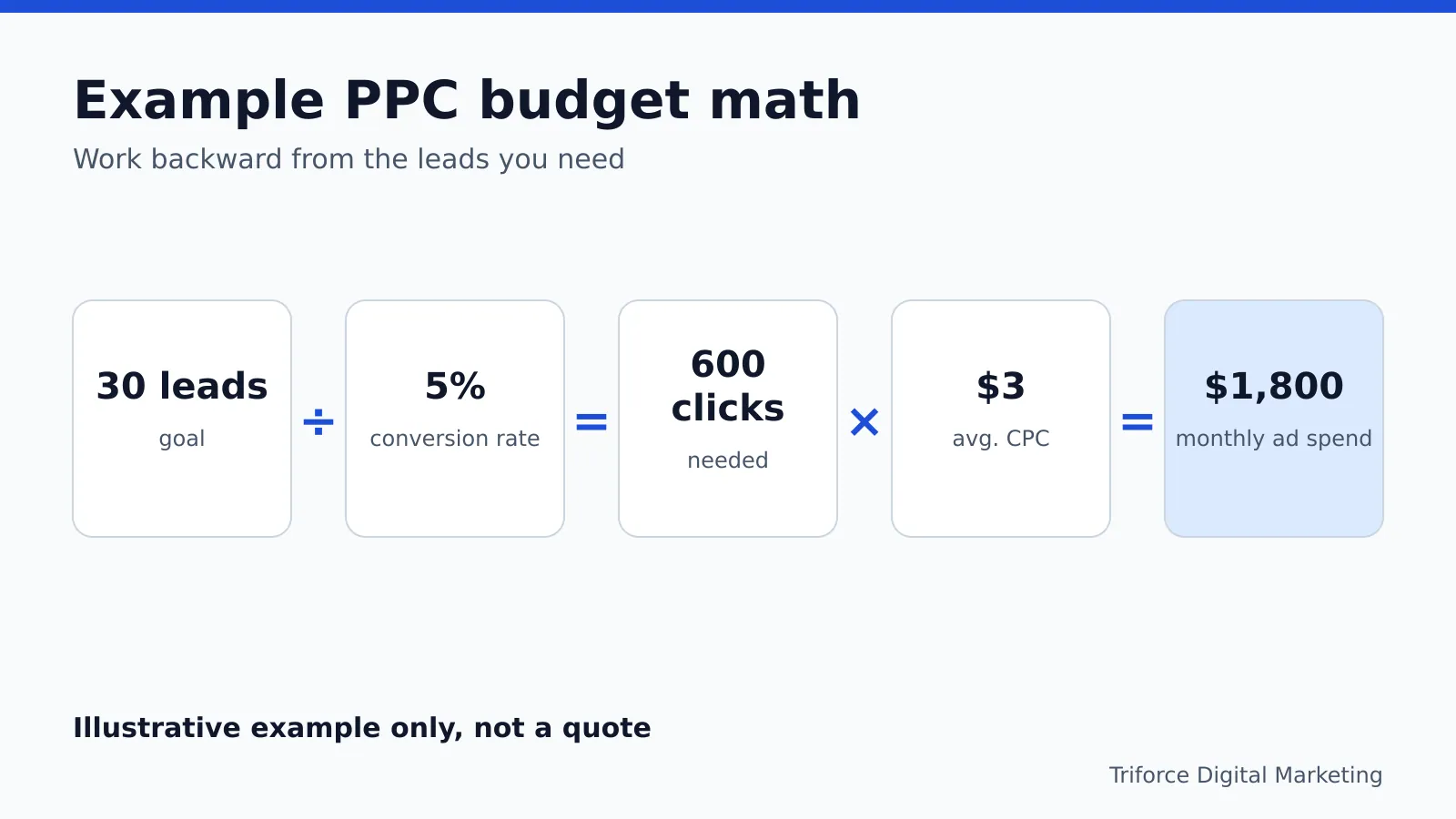
A practical way to estimate an advertising budget is to work backward from the desired number of conversions.
Consider the following example:
A business wants to generate 30 leads per month through Google Ads.
Assume the following campaign metrics:
First, calculate the number of clicks required:
30 leads ÷ 5% conversion rate = 600 clicks.
Next, calculate the estimated advertising budget:
600 clicks × $3 CPC = $1,800.
Estimated monthly advertising spend: $1,800.
This means the business would need approximately $1,800 in monthly ad spend to generate 30 leads under these assumptions.
Actual results may differ depending on keyword performance, competition, landing page quality, audience behavior, and campaign optimization.
Businesses should also account for management fees and other marketing expenses when calculating their total PPC investment.
PPC advertising costs and PPC management fees are two separate expenses that businesses should understand before launching a campaign.
Advertising spend is the amount paid directly to advertising platforms to display campaigns and generate clicks or other advertising interactions.
For example, if a company allocates $2,000 per month to Google Ads, that amount is used to fund the campaign.
Management fees cover the professional services involved in planning, creating, monitoring, and optimizing advertising campaigns.
Depending on the service provider, these activities may include:
Some agencies charge a fixed monthly fee, while others use a percentage of advertising spend or a combination of pricing models.
Businesses should understand exactly what is included before agreeing to a PPC management contract.
To learn more about working with an agency, read What to Expect From a PPC Management Agency.
Reducing PPC costs does not necessarily mean lowering bids or spending less money. The objective should be to eliminate wasted advertising spend while maintaining or improving the quality of leads and conversions.
Here are several ways businesses can improve campaign efficiency.
Negative keywords prevent advertisements from appearing for searches that are irrelevant to the business.
For example, a company offering professional web design services may want to exclude searches containing terms such as:
These searches may attract visitors who are not interested in purchasing the advertised service.
Reviewing search term reports and adding appropriate negative keywords can help reduce irrelevant clicks.
Not every keyword generates the same level of purchasing intent.
Broad keywords may attract people who are researching a topic, while specific searches often indicate that someone is closer to making a purchasing decision.
For example:
Businesses should organize campaigns according to search intent and allocate budgets based on their conversion objectives.
A campaign can generate affordable clicks but still waste money if visitors leave without taking action.
Improving landing page performance helps businesses get more value from existing advertising traffic.
Consider:
Businesses can also use conversion rate optimization services to identify opportunities to improve website performance.
PPC campaigns require ongoing monitoring to identify problems and opportunities.
Review important metrics such as CPC, CTR, conversion rate, cost per lead, and ROAS.
Identify keywords and advertisements that generate qualified conversions, and adjust budgets based on actual performance.
Avoid allowing campaigns to run for extended periods without reviewing their results.
Testing different headlines, descriptions, offers, and calls to action can help businesses identify which messages attract the most qualified visitors.
For example, a digital marketing agency might test advertisements emphasizing:
Use campaign data to determine which messaging produces the strongest results.
PPC can generate immediate visibility, while SEO helps businesses build long-term organic search traffic.
Combining these channels can reduce dependence on paid advertising over time and create additional opportunities to attract customers.
For example, PPC data can identify keywords that generate valuable leads. Businesses can then prioritize those terms in their SEO strategy and develop optimized service pages or blog content.
Explore how SEO and PPC work together to understand how organic and paid search can support a unified marketing strategy.
PPC advertising can be a worthwhile investment when campaigns are properly targeted, managed, and measured against meaningful business objectives.
However, profitability depends on more than the amount spent on advertising.
Businesses should consider their average customer value, profit margins, conversion rates, customer acquisition costs, and the quality of incoming leads.
For example, a service business may be willing to spend $100 to acquire a customer if that customer generates substantially more revenue and profit than the acquisition cost.
An online retailer with smaller profit margins may need a much lower acquisition cost to maintain profitability.
PPC is particularly useful for businesses that:
Businesses should also understand that increasing advertising budgets does not always produce proportional increases in conversions. As spending grows, campaigns may reach less competitive audiences or less valuable search opportunities.
For a deeper explanation, read Triforce’s guide to PPC curves and diminishing returns.
Managing PPC campaigns requires research, technical knowledge, and continuous optimization. Businesses without the necessary experience may benefit from working with a professional agency.
When comparing PPC management providers, consider the following:
Experience and Expertise: Look for an agency with experience managing campaigns relevant to your industry and business objectives.
Transparent Pricing: Make sure the provider clearly separates advertising spend from management fees.
Campaign Reporting: Ask how often performance reports are delivered and which metrics are included.
Conversion Tracking: Confirm that the agency can measure valuable actions such as calls, purchases, and form submissions.
Optimization Process: Understand how the agency reviews keywords, adjusts bids, tests advertisements, and improves campaign performance.
Communication: Choose a provider that explains campaign performance clearly and provides actionable recommendations.
Businesses can also review how to choose the best digital marketing agency for a small business.
Triforce provides PPC management services designed to help businesses develop targeted advertising campaigns, manage advertising budgets, and improve campaign performance.
We will work backward from the leads you need and show you the data behind every move. Book a Free Strategy Session with Triforce and talk through your next step.
So, how long does PPC take? PPC advertising can start generating traffic and clicks within
A PPC audit is a comprehensive evaluation of a pay-per-click advertising campaign to identify performance
PPC optimization is the process of improving pay-per-click advertising campaigns to increase conversions, reduce advertising